Ski trips at the end of a busy term: is it really a holiday? Whatever the brochure says, for a young athlete’s body it is a training block.
Liz Robson, Head of Performance Physiotherapy, Lead for Sport Performance & Athlete Development
Somewhere in a wardrobe near you, a pair of salopettes is waiting to be tried on. They will not fit. Nobody will be surprised, and someone will be making an emergency trip to the outdoor shop by the weekend.
Kit sorts itself out with very little prep. The person wearing it needs a little more planning.
A week of skiing means five or six hours a day on snow, often six days in a row. That is a serious training load, and it usually arrives straight after the busiest weeks of the school year: fixtures, rehearsals, concerts, carol services, mocks, parties and a lot of dark evenings.
It also matters because teenagers are the age group most likely to get hurt on the slopes. Canadian research found that 13 to 17-year-olds had the highest injury rate of any age group, and that children skiing with school groups were injured more often than peers skiing outside them.
That is not an argument against ski trips. They are brilliant (trust me, I am their biggest fan). It is an argument for preparing for them properly.
A ski trip at the end of a busy term is not a break from the season. It is part of it.
Three pupils, one mountain
In a recent blog, There Is No Such Thing as a “School Athlete”, Dr Sam Barke described the very different young people who sit side by side in school sport. You will find the same spread on most ski trips, so let’s follow three of them through the next six weeks.

The racer is on a ski scholarship, chasing FIS points and heading to a race camp. Their normal week already holds dry slope training and a structured gym programme, alongside school sport, lessons, homework and the same end-of-term mocks as everyone else. They are surrounded by support, from ski coaches to school staff, but that support does not always talk to each other. Their challenge is coordination.
The multisport athlete plays hockey, netball and cricket for school and fits skiing in around all of it. Add lessons, homework, mocks, a couple of end-of-term parties and the odd late fixture, and there has not been a free evening since September. Every coach sees their own programme. Very few people see the whole week. Their challenge is visibility.
The holiday skier is off with friends, family or the school trip after a term of coursework deadlines, mocks, drama rehearsals, music practice and monitor duties, with the school play, the carol service and a Christmas party or three squeezed into the final weeks. They are busy and often tired, and have done very little structured exercise since September. Their challenge is preparation.
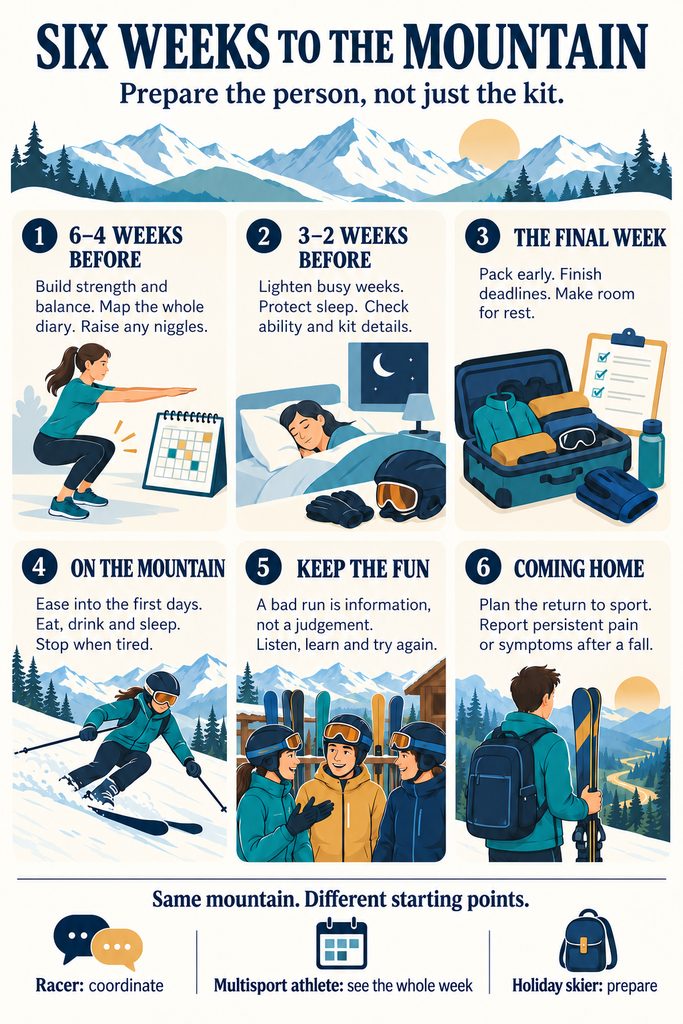
Same mountain. Very different starting points.
Six to four weeks out: get a starting point
This is the most useful window, and the one most people miss.
Check in with the physio. If anything has been niggling, now is the time, not the week before they fly. It is also worth thinking about growth. A pupil who has shot up this term can find their knees, heels or back less tolerant of a sudden jump in load, and a week on snow is a very sudden jump.
Start building ski legs. Skiing is not a sport of big one-off efforts. It relies on controlled strength through the legs, balance on a constantly changing surface and the endurance to hold a bent-knee position for hours at a time. The good news is that all of these respond well to focused preparation, and two or three short sessions a week over the next six weeks can make a real difference. Talk to your S+C team or Physo for help planning and focus on:
- slow lowering in squats, split squats and step-downs (three seconds on the way down is harder than it sounds, which is rather the point)
- single-leg balance, made awkward with eyes closed or head turns
- longer holds in a ski position, such as wall sits, because a day on snow is hours of bent knees
- hips and ankles that move well

Map the whole term, not just the sport. Put fixtures, training, rehearsals, concerts, mocks, deadlines and parties on one calendar. Most families spot two or three pinch weeks straight away.
For our three pupils:
- The racer agrees with the ski coach and whoever runs their gym programme what this block is for, ideally in the same conversation. A technical camp and a race block are different animals, and the gym work should point the same way as the skiing.
- The multisport athlete shares that one calendar with every coach. Nobody can plan around Saturday’s hockey match, or a week of skiing, if nobody mentions it.
- The holiday skier starts small. Two short sessions a week fit around rehearsals far better than an ambitious plan that lasts a fortnight.
Three to two weeks out: protect the run-up
Now the diary fills up, and this is where good intentions usually go to die.
Lighten the pinch weeks. If the dress rehearsal and a big match land in the same week, ask now whether a gym or training session can be swapped or shortened. Coaches and teachers are far more flexible with three weeks’ notice than with three hours’.
Protect sleep. Late rehearsals and parties push bedtimes back, and dark mornings do not help anyone get up. Keep wake-up times fairly steady, get some daylight at break and guard a couple of quiet evenings.
Fill in the forms honestly. Teenagers have a habit of upgrading their ability to get into the “good” group, and guessing their height and weight for the hire shop. Lesson groups and binding settings depend on both, and badly adjusted bindings and hired kit are linked to more injuries in young skiers. The same goes for the medical form. If a pupil has a niggle, it belongs on the form, so staff can help manage it rather than discovering it halfway down a red run.
The boring truth is the safer option.
For our three pupils:
- The racer starts easing off the gym work, so they arrive fresh rather than sore.
- The multisport athlete decides what to leave out for a few weeks. That is hard when you enjoy everything and do not want to let anyone down, so the adults around them need to help. Nobody should have to negotiate between four different coaches on their own.
- The holiday skier goes for less adding and more protecting: time to eat, sleep and occasionally sit down without a laptop open.
The final week
- Finish the schoolwork. Coursework does not belong on a chairlift. Get deadlines met before they go, and the laptop can stay at home.
- Be realistic about the social calendar. Nobody is suggesting a festive lockdown. Just avoid the biggest night of term landing on the evening before they travel.
- Respect winter bugs. If a pupil has a temperature or feels generally rotten, rest beats training through it.
- Pack early. Boots, helmet, goggles, sun cream and any medication go in hand luggage. Lost luggage is annoying. Lost ski boots are a disaster.
For our three pupils:
- The racer does nothing new. Short, sharp sessions only, race skis serviced and packed, and a quick conversation with the coach about how the first days at camp will run, so they arrive fresh and know the plan.
- The multisport athlete may well have a match the day before departure. That is the moment to talk to coaches about reduced minutes or sitting it out, rather than heading to the airport straight from a full game on tired legs. There is also the risk of a last-minute injury to weigh up. A sprained ankle in the final fixture of term can cost a lot more than a missed match.
- The holiday skier is juggling the last rehearsals, the carol service and the end-of-term parties. Keep the short sessions ticking over rather than cramming in extra ones, and protect a couple of early nights before travelling.
On the mountain
The start of a trip carries the most risk. In an Austrian study of injured holidaymakers, mostly adults, a third were hurt on their first day on the slopes and almost a quarter on their second. A more recent study found risk peaked again around day three, as tired legs and short nights catch up.
The first two or three days deserve the most respect.
That first day is busy even before anyone clicks into a binding. A new hotel, often on the first trip away without parents, means setting their own alarm, making it to breakfast and getting everything onto the bus. Then come hire boots that felt fine in the shop but now pinch, a new lift map and thinner air. None of that is skiing yet, but all of it uses energy after a long journey and a short night. Once on the snow, every skier has to get used to movements their body has not met for months (or ever if a beginner), often on already tired legs, and racers have to switch from dry slope technique to snow. Everyone needs a few runs to find their feet before judging themselves on any of it.
A few things make the biggest difference once they are there:
- Fuel. Breakfast, a snack in the pocket and a proper lunch. Hot chocolate is not a food group.
- Sleep. Shared rooms, phones and the unofficial first-night tradition of staying up leave plenty of pupils running on empty by day three. Phones away and lights out are not a punishment.
- Helmets and head knocks. A helmet on every run. Any bang to the head reported to staff straight away, even if the pupil feels fine. If in doubt, sit them out.
- Friends. Teenagers take more risks when their friends are watching, so they need to know it is fine to say no to a run beyond their ability, however cheerfully someone promises “you’ll be fine on this one”. Famous last words.
- The last run. By late afternoon the snow is chopped up, the light is flatter and legs have done hours. Stopping while they still feel good is a habit worth encouraging.
For our three pupils:
- The racer is facing the most intense block of their season so far: back-to-back days of drills, gates, timed runs and video analysis. The temptation is to chase times on day one. The smarter move is to use the first sessions to adjust to the snow, warm up properly before every run, and tell the coach about any niggles early rather than skiing through them.
- The multisport athlete arrives with a full term already in their legs. Fatigue will build faster than they expect, and day three is often where it shows (the mid week slump). Shorter days early on, proper meals and as much sleep as a shared room allows will make the second half of the week far more enjoyable.
- The holiday skier may be in lessons in the morning and skiing with friends in the afternoon, and the hardest part is often keeping up. They need to know it is fine to take a break, choose an easier run or call it a day early. None of that is missing out.
When it does not go to plan
At some point on the trip, something will not go to plan, and that is completely normal. A slow time or a missed gate for the racer. Legs that will not do what they are told for the multisport athlete. A group lesson that moves faster than the holiday skier, or a full yard sale, with skis, poles, goggles and a fair bit of dignity scattered across the hill.
It is easy for a young person to turn that into “I’m just not good enough”, and a confident face at the bottom of the slope does not always mean they are taking it well.
A bad run is information, not a judgement.
Sometimes what they need first is a hot chocolate and someone who listens, not a frame-by-frame breakdown. When the conversation does come, “What went well?” opens far more doors than “Where did you finish or what went wrong?”

For some pupils, the hardest part is not on the slope at all. Homesickness and friendship-group wobbles are common on a first trip away, so make sure pupils know before they go who they can talk to on the trip.
What should parents, coaches and trip leaders look for?
Nobody needs to screen every pupil before a ski trip. But some situations are worth a second look:
- a pupil carrying a niggle they are reluctant to mention
- someone who has grown noticeably this term
- an athlete whose last month has had no quiet evenings at all
- a holiday skier booked into a group well above their recent experience
- a multisport athlete with a fixture straight after the return flight
At that point, the question moves beyond “Have they got all their kit?” to:
“Are they actually ready for what the week will ask of them?”
Coming home
Six days, or more, of skiing is a significant block of load, and the return deserves the same planning as the departure. Agree before the trip how training will build back up, and expect tired legs for a few days. Persistent niggles that will not settle, like a knee that aches, swells or gives way, or a shoulder pain they just cannot shake, are worth getting checked by a physio or doctor. And any headaches, dizziness or feeling foggy after a fall should always be raised.
For our three pupils:
- The racer may only have days before the next race or training block. A short recovery period, a review of the camp with the ski coach and gym coach together, and a gradual return to heavier gym work will serve them far better than going straight back in at full volume.
- The multisport athlete, whose season does not stop when term ends, may be flying home on Sunday and playing a full match on Wednesday. That is a big ask. Every coach needs to know how the week went, so the first week back can be built up rather than started at full load. This is where that shared calendar earns its keep.
- The holiday skier heads into the Christmas holidays and then back into school sport in January, often with tired legs and a few aches. Easing back in matters, and the good news is that the strength work started before the trip is worth keeping going. It is a great foundation for the rest of the season.
Joining it all up
Planning a trip from the first pinch week to the first match back is exactly what we enjoy in the Sport Performance & Athlete Development (SPAD) department of Meliora Medical. We work alongside school physio, medical and pastoral teams, not just when something goes wrong but throughout a young athlete’s development. We’re interested in understanding the whole athlete, not just their current performance, and helping schools, coaches and families make informed decisions about training and development.
A ski trip is a perfect example of that, so if one of our three pupils sounds familiar, speak to your school medical team. They can bring us in well before those salopettes come out of the wardrobe.
Healthy. Strong. Ready to Perform.
The bigger picture
Physical preparation cannot guarantee an injury-free trip, and nor should every ache become a reason to stay at home. The goal is proportionality.
The racer needs a plan that joins up. The multisport athlete needs someone to see the whole week. The holiday skier needs a little preparation and a lot of protecting. None of it is complicated. Most of it simply needs to start now, with six weeks still to go, rather than the week before the flight leaves.
And when they get home, alongside “How did you do?”, try:
“What did you learn, and what made you want to go back?”
Skis get serviced every season. The young people standing on them deserve the same attention.