
Dr Mike Forsythe, Lead for Head Injury & Concussion Care
Earlier this month, members of the Meliora Medical team attended the European Sports Concussion Conference (ESCC) in Nice, France. Bringing together leading clinicians, researchers, healthcare professionals and sporting organisations from across Europe and North America, the conference focused on the latest developments in concussion diagnosis, treatment, rehabilitation and prevention.
The meeting provided an opportunity not only to share our own research but also to reflect on how the international evidence base continues to evolve. The reassuring message from many of the world’s leading concussion experts was that the principles increasingly recognised as gold-standard care are already well established at Meliora.
Sharing Meliora’s Research
We were proud to contribute two research projects to the conference programme.
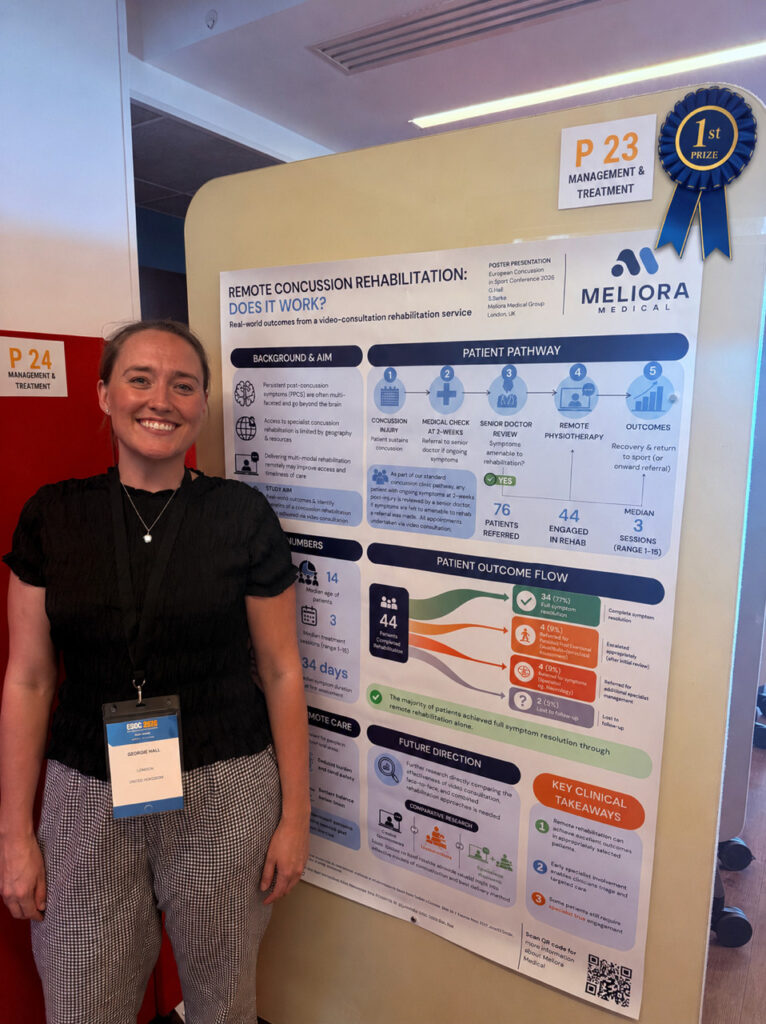
Georgie Hall presented her poster, Remote Concussion Rehabilitation: Does it Work?, which explored outcomes from our specialist telehealth concussion rehabilitation service. The study demonstrated that more than three-quarters of patients who engaged with remote rehabilitation achieved complete symptom resolution, highlighting the potential for specialist concussion care to be delivered effectively beyond traditional clinic settings. Importantly, the work also identified circumstances where face-to-face assessment remains essential, reinforcing the importance of delivering the right care to the right patient at the right time.
The research attracted significant interest from delegates throughout the conference and was ultimately awarded first prize in the poster competition.
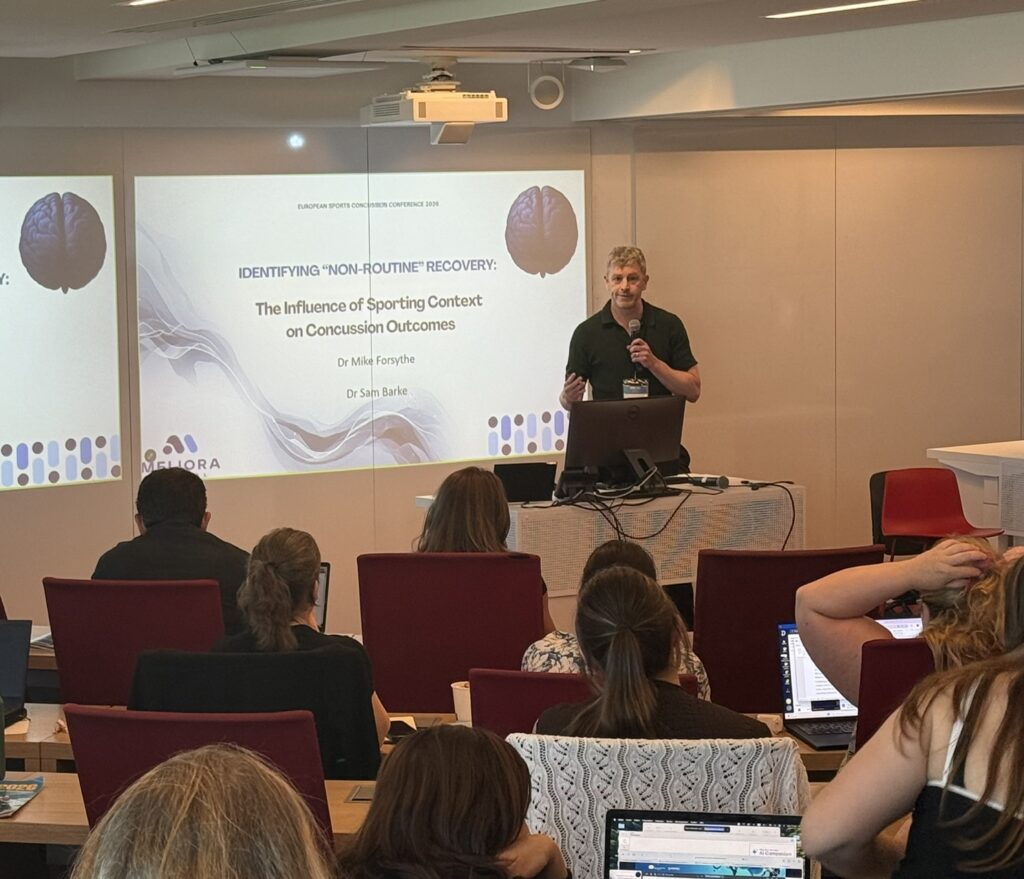
Dr Mike Forsythe presented our research examining “non-routine” concussion recovery. Rather than focusing solely on symptom duration, this work explored clinically meaningful outcomes such as delayed return to school, work or normal daily functioning. Analysing over 4,000 concussion cases, the study demonstrated that the risk of prolonged or complex recovery differs significantly between sporting and non-sporting contexts. Interestingly, rugby, despite its high profile within concussion discussions, demonstrated lower rates of non-routine recovery than many other activities.
These findings highlight the importance of early identification of patients at risk of prolonged recovery and the need for timely access to specialist support.
The End of “Just Rest”
Perhaps the strongest and most consistent message throughout the conference was that concussion management has moved decisively beyond prolonged rest.
Multiple sessions focused on the importance of early assessment, early activity and targeted rehabilitation. International experts discussed the evidence supporting prompt specialist review, early identification of vestibular, visual and exercise intolerance problems, and active rehabilitation tailored to the individual’s presentation.
For athletes, parents and schools, this is an important message. Recovery from concussion is no longer viewed as a passive process. The goal is not simply to wait for symptoms to disappear, but to actively support recovery through appropriate management and rehabilitation.
Technology Is Advancing Rapidly – But Clinical Expertise Remains Central
One of the most exciting aspects of the conference was the breadth of emerging technologies being explored.
Presentations covered advanced neuroimaging, blood-based biomarkers, artificial intelligence, electrophysiology, instrumented mouthguards and other innovative approaches aimed at improving concussion assessment and diagnosis.
While these developments are promising, a common theme emerged throughout discussions: no single test currently provides a definitive answer for concussion diagnosis or recovery. Technology continues to evolve, but expert clinical assessment remains the cornerstone of effective care.
For patients and families, this reinforces an important point. Sophisticated tools may enhance decision-making, but they do not replace the need for experienced clinicians who understand the complexities of concussion and can interpret findings within the wider clinical picture.
Understanding Why Some Recoveries Take Longer
Persistent symptoms following concussion remain one of the greatest challenges in sports medicine.
Several keynote presentations focused on persistent post-concussion symptoms, vestibular and visual dysfunction, psychological factors, sleep disturbance and long-term outcomes.
The emerging consensus is that prolonged recovery rarely has a single cause. Instead, symptoms often arise from a combination of physiological, vestibular, visual, cervical, psychological and behavioural factors. Effective management therefore requires a multidisciplinary approach that identifies and addresses the specific drivers of symptoms in each individual.
This philosophy closely mirrors the model of care delivered at Meliora Medical, where concussion is viewed as a complex injury requiring personalised assessment and rehabilitation rather than a one-size-fits-all approach.
The Continuing Challenge: Access to High-Quality Concussion Care
Perhaps the most striking theme was one that extends beyond research findings.
Despite significant advances in concussion science, access to specialist concussion care remains inconsistent across many healthcare systems. Discussions around policy, education and care pathways highlighted ongoing variation in how concussion is recognised, assessed and managed.
For many patients, uncertainty still exists around what activities are safe, when they can return to school or work, and where they should seek support when symptoms persist.
Improving access to evidence-based concussion care will require continued collaboration between healthcare providers, schools, sporting organisations and policymakers.
Looking Ahead
The European Sports Concussion Conference reinforced how rapidly the field continues to evolve. New technologies, novel treatment approaches and growing research collaborations are helping to advance our understanding of concussion and improve patient outcomes.
At the same time, the conference provided reassurance that many of the principles now considered international best practice—early assessment, active management, targeted rehabilitation and multidisciplinary care—are already embedded within the services we provide every day.
As concussion research continues to develop, Meliora Medical remains committed to contributing to the evidence base, translating emerging research into clinical practice, and ensuring that patients have access to the highest standards of concussion care.