
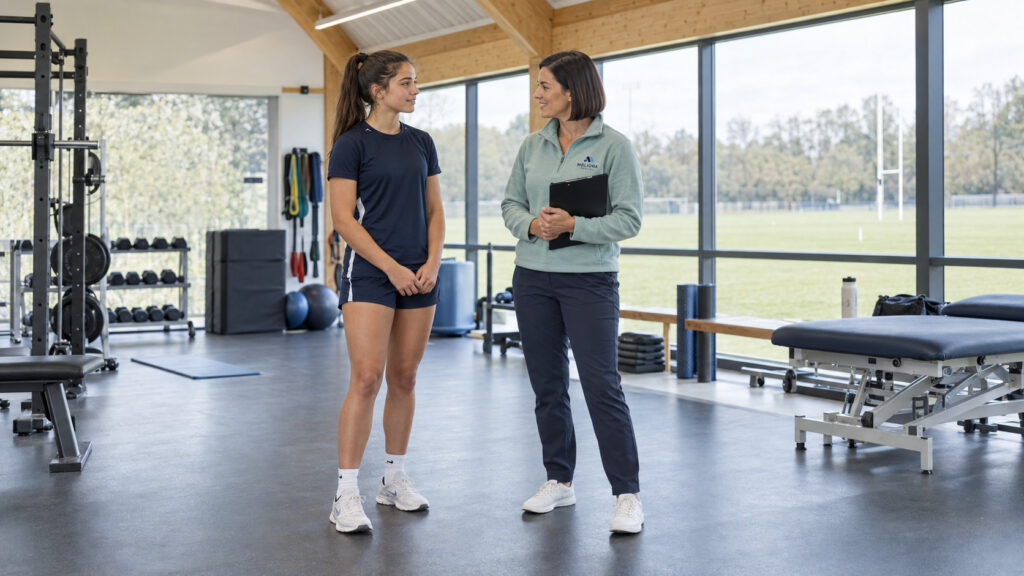
Liz Robson, Head of Performance Physiotherapy, Lead for Sport Performance & Athlete Development
“When can I play again?” It’s a question I hear all the time, and understandably so. Young people recovering from injury want to be back with their friends, back in the team and back doing something they love.
For me, it opens up another question: what are we returning this young person to?
Because being medically fit and being ready to perform are not the same thing. Closing the gap between
the two is what performance physiotherapy is all about. And that starts with understanding the individual athlete: their sport, their position and what matters to them. That is where every rehabilitation plan we build begins.
When the game stops following the plan.
Take rugby, for instance. Running comfortably in a straight line gives us plenty of useful information, but we also need to consider acceleration, braking, change of direction, contact and repeated efforts. On top of that, how does the athlete respond when they move from a predictable stimulus to an unpredictable opponent? Cones are wonderfully predictable. Opponents tend to be less accommodating.
In a planned drill, the athlete may know where to run, when to turn and what comes next. In a match, however, they may need to track the ball, react to an opponent and choose their next movement at speed, often while fatigued. Preparing for that combination of thinking and moving is an important part of rehabilitation, bridging the gap between being medically fit and being ready to perform.
One approach we use is the control-chaos continuum, developed by Matt Taberner and colleagues: moving from controlled, predictable drills towards more reactive sporting situations. In plain terms, we start with drills where the athlete knows exactly what’s coming, then gradually add the unpredictability of a real game as they become ready. As a bonus, they’re a lot more fun than cones.
I saw this recently with a young athlete returning from a shoulder injury. On paper, they were ready: they had passed their shoulder strength testing. But when we moved on to reactive ball throws, catching and throwing at speed in response to an unpredictable cue, the power simply wasn’t there. Strong in a controlled test, not yet powerful when it counted. Had we stopped at the strength numbers, they would have gone back to sport fit, but not ready. Instead, it showed us exactly what to train next.
Every sport has its own movement patterns and situations to respond to, so we tailor progression to the sport and the individual.
Make the next step clear.
In my experience, adolescent athletes respond really well when they know what comes next and what they need to work on. Understanding what they are working towards can make rehabilitation feel more purposeful while they are sidelined.
Our return-to-sport and return-to-performance frameworks give that progression a tangible structure, with objective markers and clear steps pupils and their teams can understand. We consider what the athlete can demonstrate and how they respond, alongside the injury itself and the healing process. They build on the international consensus, led by Clare Ardern and colleagues, that getting back to sport happens in stages: back to training, back to playing, then back to performing at their best.
Understanding readiness.
We’re fortunate to have access to force plates (ForceDecks, for those of us in the biz) and handheld dynamometry at our 48 Wimpole Street clinic. Put simply, these measure how much force an athlete can produce, how quickly, and how evenly between left and right, along with a whole host of other useful metrics, so we can track progress objectively over time. Where those resources are not available in school, we can offer specialist testing to support the in-house clinician. We interpret the results alongside their assessment, the athlete’s response to training and their confidence, then share the findings to guide the next step. And athletes enjoy being part of that – there is nothing quite like a teenager watching their numbers go up.
Of course, numbers are only part of the picture.
We also consider sleep, nutrition, growth, academic demands, social pressures and psychological readiness. We draw on the school team’s knowledge of the athlete, shape the plan with the young person and family, and involve other professionals where needed.
Three questions before full training.
Whether or not we are involved, these are three questions any school team can ask before a pupil
goes back to full training:
1. Can they do it when it’s unplanned?
Changing direction, decelerating, tackling or throwing in response to an opponent or cue, not just in a set drill.
2. Can they do it when they’re tired?
The end of a session or match is usually when sport asks its hardest questions.
3. Do they feel ready?
Confidence is part of readiness. If a pupil is hesitant, that is information worth listening to.
Working together around the athlete.
Sometimes a school physiotherapist wants to talk through a complex case or a pupil who has had repeated setbacks. Sometimes an athlete needs more focused preparation for contact or competition. That is where our department can offer additional specialist support.
For a school clinician, that might mean referring a pupil to Wimpole Street for testing and using the findings together to refine their program. For more complex rehabilitation, we can take on an agreed part of the pathway, keeping the school team involved. I also offer specialist case discussion and mentoring, building on clinicians’ expertise and knowledge of the pupils.
We work alongside school physiotherapists, school and sports doctors, medical teams and coaches, as well as academy and England pathway medical teams. Between school, club, academy and county, some pupils have more medical teams than PE kits, so keeping everyone joined up really matters.
The aim is to give the school team something they can use: clear rehabilitation priorities, guidance on training participation and an agreed next step. With the athlete at the centre, we help everyone work towards the same goals.
For me, it comes back to helping young people return to the sport they love, not just medically fit, but ready for everything it asks of them. That’s what we’re working towards in Performance Physiotherapy, and it reflects Meliora’s Sport Performance & Athlete Development vision:
Healthy. Strong. Ready to Perform.
To discuss specialist support for an athlete and their existing team, speak to your Meliora clinician or contact info@melioramedical.co.uk.