
Dr Alex Maxwell, GP and Head of School Medicine
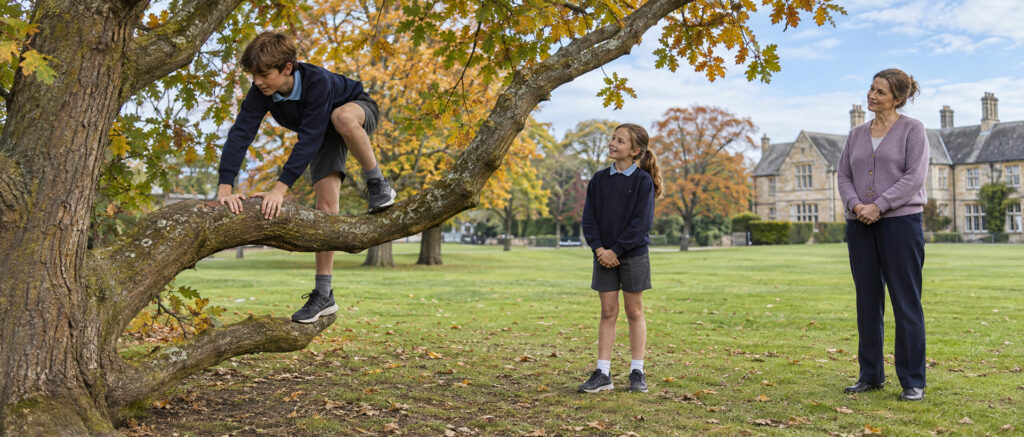
It never happens all at once. A child grazes a knee climbing the big tree, so climbing is banned. Someone twists an ankle on the wet field, so the field closes from October to March. A parent complains after their child was uncomfortable overnight, so the residential becomes a day trip.
Every one of those decisions was sensible on the day, and each has an incident form behind it. Add them up over ten years and you get a school where very little goes wrong, but children can’t do much themselves.
As a GP in school medicine, I keep coming back to one question: how do we raise children and young people who are resilient and happy as well as safe? I don’t think this has ever mattered more.
Over a million children in England had an active referral to NHS mental health services in 2024-25, and more than a third were still waiting at the end of the year. The Children’s Commissioner’s new report, The Childhood Lottery, shows how much that wait, like so much else in a child’s life, depends on where they happen to grow up. It made for heartbreaking reading, and I’ll be writing about it properly soon.
None of us can fix that on our own. But everyone who looks after children, at home, at school and in the communities around them, shapes the everyday freedom to take risks that helps children learn to cope.
Whatever happened to playing out?
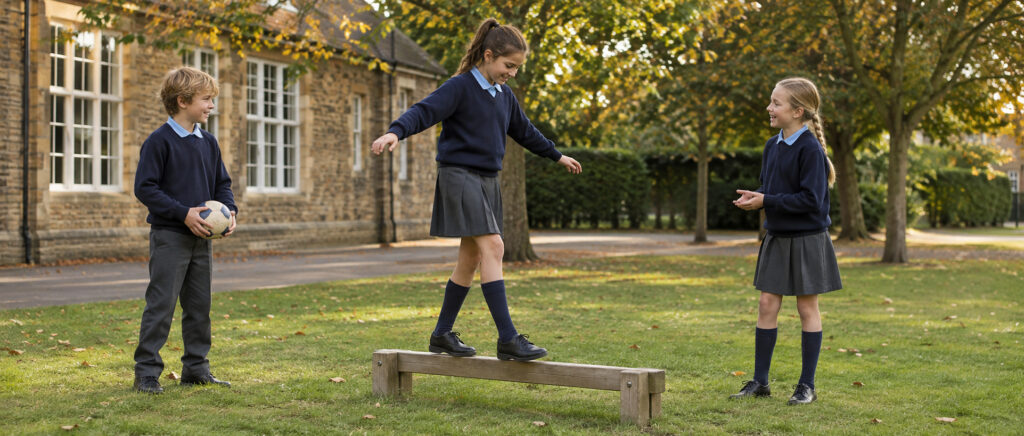
In 1971, 86% of primary school children in England were allowed to travel home from school on their own. By 2010 it was 25%. In 2020, children were nearly 11 on average before they could play outside without an adult, almost two years older than their parents had been. Since 1995, break times have shrunk by 45 minutes a week for the youngest pupils and by more than an hour for secondary pupils.
That matters. In October, Rachel Ramsden, Helen Dodd, Mariana Brussoni and colleagues published an excellent systematic review in PLOS One that brought together 74 studies of outdoor risky play in children aged 3 to 12. Children who got more of it tended to be more active, more confident, more sociable and better at judging risk, and their injuries were mostly scrapes and bruises.
We should acknowledge the review’s limits. Most of the studies show association rather than cause, and only a quarter were high quality. On balance, though, it says lean towards letting children try. I agree, and I’ll explain why.
What about teenagers?
The review stops at 12, but in my work with teenagers the principle carries on. It just looks different. For a fifteen-year-old, risky play is getting into town alone, a Saturday job, or trying out for a team and not getting in.

Teenagers will take risks whatever we do. What we can influence is which ones, and who’s around when they do. Natasha Duell and Laurence Steinberg found that teenagers who take positive risks, where the worst outcome is disappointment, are thrill-seekers too, but less impulsive and more connected to school than those taking negative risks like drugs or reckless driving. Close off the healthy outlets and the appetite goes looking elsewhere.
Some of the most valuable independence I see is in health. A sixteen-year-old who can tell when a symptom needs a doctor, book their own appointment and manage their own medicines has learned something for life. Doing it for them is quicker. It isn’t kinder.
Why it only runs one way
Wanting to protect children is the right instinct, but it weighs two very different kinds of harm. The harms of taking risks are short-term and visible: a graze, a bruise, now and then a broken wrist, all recorded and almost all healed within weeks or months.
The harms of avoiding risk build slowly and out of sight: fitness and strength that never quite develop, children who never find out they can be frightened and cope, teenagers who can’t handle a setback without an adult stepping in. Preventing a broken wrist is a real gain. But it isn’t the only consequence.
Other pressures push the same way, and all of them are understandable. We want someone to be at fault. The BMJ stopped using the word ‘accident’ in 2001 because most injuries are predictable and preventable, and on the roads that thinking saves lives. In the playground, it means every graze needs a culprit.
Hindsight makes any decision that ends in a broken wrist look careless, while the rule that stops a whole year group climbing is never questioned because it appears ‘safer’ in the moment. Rules only ever get added, because lifting one means someone accepting that specific risk.
Then there’s the fear of being sued, which is real but might be bigger than the law behind it. Courts can consider whether extra precautions would stop a worthwhile activity, and must consider whether someone acted responsibly. In 2003, Lord Hoffmann warned against banning ‘the harmless recreation of responsible parents and children’. Even the Health and Safety Executive, not famous for its love of tree-climbing, says fear of prosecution has got out of proportion. I’m not a lawyer, and no school is immune from claims, but the law backs sensible risk more than most people realise.
Risk, hazard and safeguarding
A risk is something a child can see, weigh up and choose to take. A hazard is a danger they can’t recognise or manage. A high branch is a risk. A rotten one is a hazard. Good risk management removes the hazards as best it can and keeps the risks worth taking, which is where organisations responsible for children, and some individuals, can go wrong. They treat a risk as a hazard.
I am deeply involved with safeguarding in a variety of ways, and it’s important to emphasise that none of this weakens it. Every child is owed protection from abuse, exploitation and neglect, and that duty comes first. Those are hazards, and no child should be left to manage them alone.
Where the line sits also depends on the child. A climb that’s a sensible risk for one pupil can be a hazard for another with poorly controlled epilepsy, and a trip into town that builds one teenager’s confidence can expose another to exploitation. Vulnerable children, including those with SEND, a medical condition or a social worker, need plans made with them and the people who know them best. They often have the most to gain from supported independence, so the answer is usually adjustments rather than a blanket no.
The medical question comes after the fall: how badly hurt is this child? A sensible risk can still end in a significant injury, and a hazard in nothing worse than a fright, so the injury tells you how to respond, not whether the decision and governance were right. A head injury, a suspected fracture, an allergic reaction or a child who seems unwell needs the full response every time, and the serious ones a proper review afterwards.
But when staff aren’t sure where that line sits, every bump becomes a possible head injury, and children learn that any discomfort needs an adult to fix it. Good school medicine includes knowing when simple care and a kind word are enough.
What we can do
Resilience is relational. Harvard’s Center on the Developing Child found that children who do well have had at least one stable, committed relationship with a supportive adult. It’s built through supported independence: taking on something hard with a trusted adult close enough to help and far enough back to let them try.
That’s a job for families, communities and government as well as schools. But schools are mainly where I work, so I’ll start there.
Heads and governors
Acknowledge together, and in your policies, that minor injuries are part of a full childhood. Write a short risk-benefit assessment before anything goes wrong. It’s good practice, and good evidence of a responsible approach. Give new restrictions a review date.
When a child is hurt, say sorry and explain what happened, because in law an apology isn’t an admission of negligence. And when a sensible decision ends in a broken wrist, back your staff and review it for learning rather than blame, as the NHS now does with patient safety incidents.
Pastoral and boarding staff
Build independence in steps and give the appetite for risk good outlets: expeditions, performance, leadership, real responsibility. Let pupils fail at things that matter. Ask them how the school should approach risk, and show them what you changed as a result.
Medical and nursing teams
Keep the hazard list sharp, with clear protocols, trained staff and regular review. Give pastoral staff a simple routine for minor injuries (look, reassure, clean up, encourage), so not every graze ends up in the medical centre. And help older pupils to manage their own health.
Parents
Agree with the school in advance how you’ll hear about minor injuries, and judge the decision as well as the outcome. Hand over independence at home in steps: journeys, cooking, money, appointments. And resist the rescue. A missed deadline at 13 is smaller than one at 17.
Beyond the school gate
Every child has a right to play under Article 31 of the UN Convention on the Rights of the Child. Yet England dropped its national play strategy in 2010 and, unlike Wales and Scotland, has no legal duty on councils to secure enough play. I’d like to see three things:
- A national play strategy for England, backed by a duty on councils to secure enough play.
- Inspections that ask how a school balances risk and benefit, not just how few incidents it records.
- Protected break time, with DfE guidance that it shouldn’t be withheld as a sanction, as nearly six in ten schools did in 2019.
School will never be risk-free, and we shouldn’t want it to be. So before the next sensible rule goes in, ask what it will cost as well as what it will prevent.
Dr Alex Maxwell is a GP and Head of School Medicine at Meliora Medical.
References
- Children’s Commissioner for England. Children’s mental health annual briefing 2024-25. July 2026.
- Children’s Commissioner for England. The Childhood Lottery. October 2026.
- Shaw B, Watson B, Frauendienst B, et al. Children’s independent mobility: a comparative study in England and Germany (1971-2010). Policy Studies Institute. 2013.
- Dodd HF, FitzGibbon L, Watson BE, Nesbit RJ. Children’s play and independent mobility in 2020: results from the British Children’s Play Survey. Int J Environ Res Public Health. 2021;18(8):4334.
- Baines E, Blatchford P. School break and lunch times and young people’s social lives. UCL Institute of Education, Nuffield Foundation. 2019.
- Ramsden R, Jerebine AG, Brailey G, et al. Outdoor risky play and health-related outcomes in children aged 3-12 years: a mixed-methods systematic review. PLOS One. 2026;21(10):e0347444.
- National Institute of Child Health and Human Development. News release on Duell N and Steinberg L’s study of positive and negative risk taking in adolescence. May 2020.
- Davis RM, Pless B. BMJ bans ‘accidents’. BMJ. 2001;322:1320-1.
- Compensation Act 2006, sections 1 and 2.
- Social Action, Responsibility and Heroism Act 2015.
- Tomlinson v Congleton Borough Council [2003] UKHL 47.
- Health and Safety Executive. Children’s play and leisure: promoting a balanced approach.
- Harvard Graduate School of Education. The science of resilience (reporting the National Scientific Council on the Developing Child). March 2015.
- NHS England. Patient Safety Incident Response Framework. 2022.
- Play England. Play England welcomes stronger protections for play in the new NPPF. August 2026.
Explore how Meliora Medical’s School Doctor Service can support your school: info@melioramedical.co.uk