
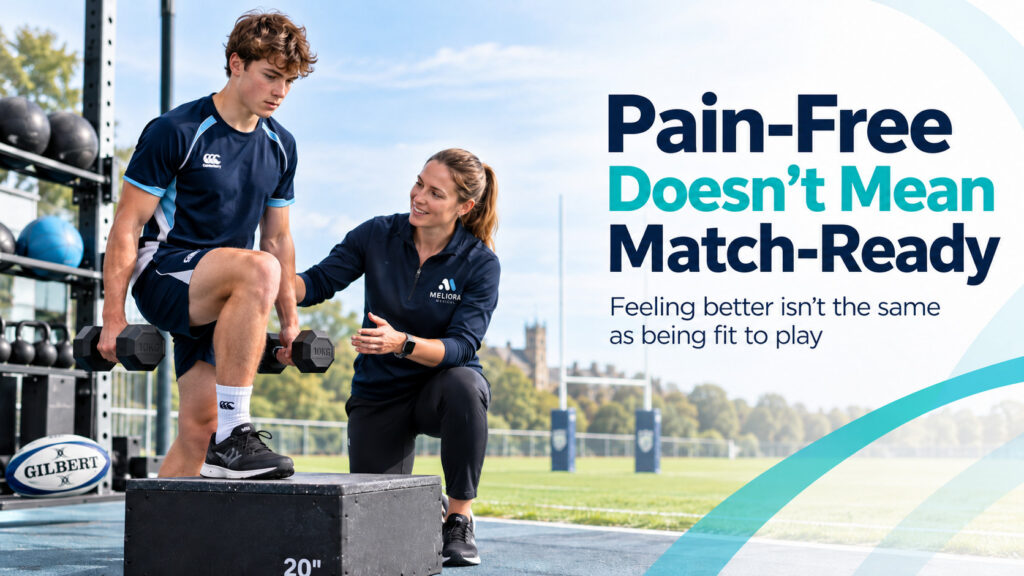
Feeling better isn’t the same as being fit to play
Dr Sam Barke, Head of Sports Medicine
Despite some early-season disruption from unusually hard ground, the school rugby season is now well underway.
For most schools, half term is approaching. It is a natural point to pause after several busy weeks of training, fixtures, PE, strength and conditioning and, for some pupils, club sport on top.
For players carrying aches and niggles, the break can provide a valuable opportunity for rest and recovery.
But there is an important distinction between the two.
Rest can settle symptoms. Rest alone does not always complete recovery.
One pattern we see repeatedly in school sport is a player who picks up an injury – perhaps a sore knee, painful ankle, hamstring problem or ongoing groin pain. They miss a few sessions or a match. They rest. The pain improves. So they play again.
They get through a game or two, the symptoms return, they miss another week, the pain settles and they return once more.
And so the cycle continues.
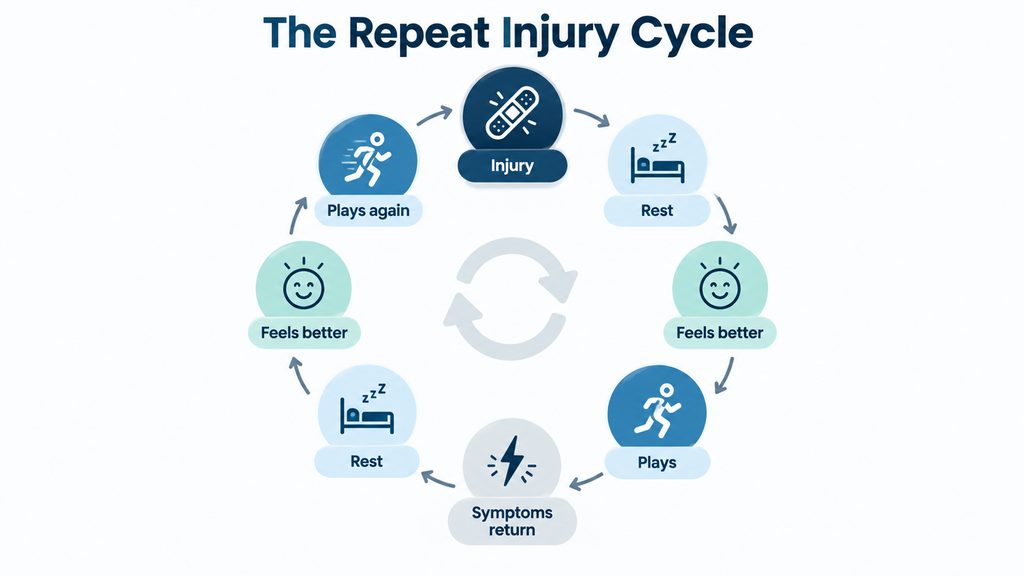
Half term can interrupt that cycle, but only if we use it properly.
The problem is not necessarily that the player has failed to rest for long enough. It may be that we have confused feeling better with being recovered.
Resolution of pain is important – but it is not a fitness test
Pain is an important part of assessing recovery. If a previously painful ankle, knee or hamstring now feels comfortable, that is clearly a positive sign.
But the absence of pain does not tell us whether strength has returned, whether the player can sprint, change direction or tolerate contact, or whether they can still do those things effectively when they are tired.
A pupil may therefore be completely comfortable walking around school but still be some distance from being ready for the demands of a competitive match.
Modern sports medicine increasingly recognises return to sport as a process rather than a single decision. The Bern consensus on return to sport describes it as a continuum and an exercise in risk management rather than simply a question of whether somebody has been medically “cleared”.
That distinction matters.
We already understand this with concussion
Concussion provides a useful comparison. We no longer simply ask whether a player feels fine while sitting in a consulting room and, if they do, send them straight back into a match.
Being symptom-free at rest is an important milestone, but return to sport involves progressively increasing physical and sporting demands and showing that those demands can be tolerated.
The international concussion consensus specifically distinguishes between symptoms resolving at rest and complete symptom resolution during maximal physical and cognitive exertion.
In other words: “I feel fine” does not automatically mean “I’m ready to play.”
The same principle applies to musculoskeletal injuries. A symptom settling is an important part of recovery. It isn’t necessarily the end of rehabilitation.
Rest can settle symptoms without restoring capacity
For some pupils, half term will be exactly what they need: a reduction in load, good sleep and time for a minor problem to settle.
But where an injury has repeatedly disappeared with rest and returned with sport, simply doing nothing for a week may only make the problem quieter.
The question is what happens when the same load is reintroduced?
If a problem appeared after 60 minutes of rugby, resting until the player can walk around pain-free and then putting them straight back into another 60 minutes of rugby is unlikely to address the underlying issue.
We have reduced the load but we have not necessarily rebuilt the capacity to cope with it.
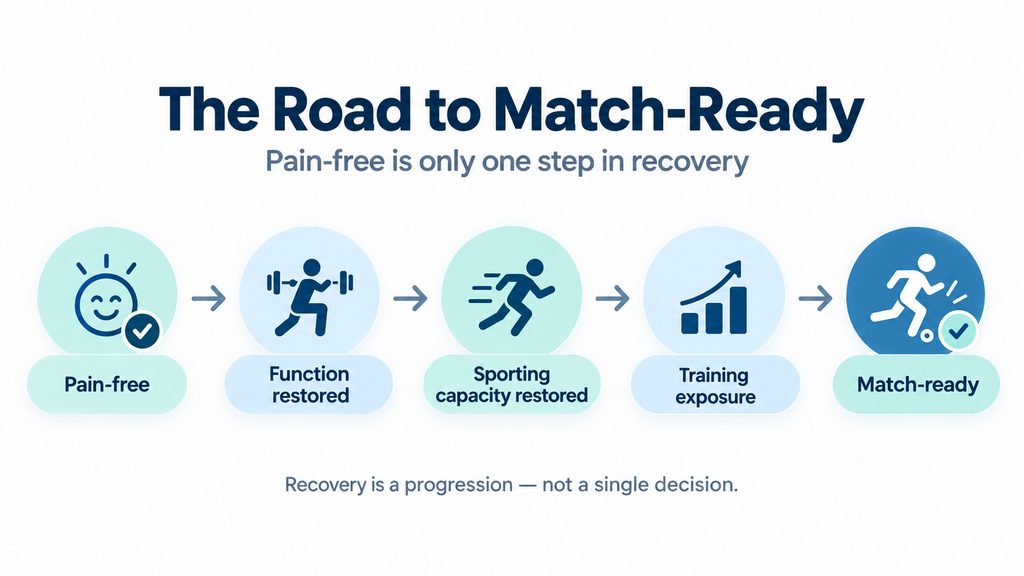
Good rehabilitation should therefore restore the physical qualities the player needs for their sport. Depending on the injury, that may include strength, movement control, running capacity, speed, change of direction, repeated efforts and sport-specific skills.
International consensus work on hamstring injury reflects this approach, recommending progression based not only on symptoms but also on the player’s capacity and the demands required for match play.
That is a very different mindset from: “It doesn’t hurt anymore, so give it a go.”
The usual pattern is understandable
It is also important not to criticise the usual approach too harshly.
A pupil gets injured. They rest. The pain improves. There is a match coming up and they want to play.
To them, the conclusion is entirely reasonable: “I feel better, so I’m ready.”
Parents may see the same thing. Coaches may see a player moving normally in training. And sometimes the return appears to go well initially.
The problem may only become obvious when symptoms return later that day, after the match or following another training session.
That is why simply telling a young person that they are “not ready” is rarely enough. They need to understand why.
Good rehabilitation depends on the player buying into the process. If all they hear is: “You can’t play yet,” it can feel like an unnecessary restriction.
If instead they understand that the aim is to rebuild enough strength, running capacity or confidence to allow them to return properly – and reduce the chance of being back in exactly the same position the following week – the conversation becomes very different.
Rehabilitation should feel like progression towards sport, rather than simply time spent away from it.
That might mean progressing through running, deceleration, acceleration, change of direction, rugby-specific conditioning, full training and then competition. The player can see the pathway back. And that matters.
The first few matches back matter
Returning to sport does not necessarily mean that injury risk has immediately returned to normal. This is particularly relevant in young rugby players.
A study involving 825 U18 rugby players found that, among recurrent injuries occurring during the same season, 78% happened within two months of returning to play.
That does not mean every recurrence could have been prevented. But it does highlight why the period after return deserves attention.
The same principle is seen even more clearly following major injuries. In astudy of young athletes following ACL reconstruction, those returning to knee-demanding sport before nine months had an approximately seven-fold greater rate of a second ACL injury than those who returned later.
An ACL reconstruction is obviously very different from the everyday strains, sprains and overload problems seen in school sport. But the underlying principle is useful: Being able to participate is not always the same as being prepared for the demands of participation.
Why this is particularly relevant in school sport
School sport creates some particular challenges. There is always another fixture coming. Players want to play. Coaches want their team available. Parents understandably see that their child is moving normally and reporting little or no pain.
And there is also rarely just one source of load. A pupil may have school training, PE, strength and conditioning, a school match and club sport all within the same week.
A coach may therefore believe they are carefully managing a return without necessarily knowing how much additional activity is taking place elsewhere.
That is why communication matters.
And it is why repeatedly resting for a few days is not always the cautious option. A player who repeatedly stops when symptoms flare but never completes meaningful rehabilitation may ultimately spend more time out of sport, not less.
Rehabilitation should prepare players to perform
The aim of rehabilitation should not simply be to make an injured body part stop hurting. It should be to restore the player’s ability to do what their sport requires.
That principle underpins much of the work within our Sport Performance and Athlete Development team.
Lead by Liz Robson, our performance physiotherapists work at the point where injury rehabilitation meets physical preparation. Rather than considering rehabilitation complete as soon as symptoms settle, the focus is on rebuilding the strength, movement quality, running capacity and sport-specific demands needed for a confident and sustainable return.
For a rugby player, that may mean progressing from strengthening into running, deceleration, acceleration, change of direction and then gradually restoring training and contact exposure.
The exact pathway will vary depending on the injury and the player. The important point is that rehabilitation is built around what the sport is going to ask them to do, not simply whether they currently have pain.
That is not about keeping pupils out of sport for longer. Quite the opposite. The aim is to get them back properly – and keep them there.
What should a coach or teacher look for?
Coaches and teachers do not need to diagnose injuries or conduct return-to-play testing. But they are often ideally placed to notice a pattern.
It is worth looking again when a pupil repeatedly rests for a few days and then returns straight into matches; when the same symptoms keep returning after competition; when they appear comfortable at low intensity but struggle at speed, with contact or when fatigued; or when they have been “carrying” the same problem for several weeks.

At that point, the question probably needs to move beyond: “Does it still hurt?”
towards: “Has this player actually rebuilt what they need to play their sport?”
Sometimes the answer will be yes and sensible monitoring is all that is required.
At other times, what they need is not another week off, but a structured period of rehabilitation and progressive loading.
Returning to sport isn’t the same as staying in sport
No return-to-sport process can eliminate injury risk. Nor should every minor ache lead to extensive investigation or weeks away from sport.
The goal is proportionality.
But when an injury repeatedly settles with rest and returns with sport, we should stop treating every recurrence as though it were a completely new problem.
It may simply be telling us that the player is repeatedly returning to a level of demand that they are not yet ready to tolerate.
Half term is a good opportunity to recover. For some pupils, that will simply mean rest. For others – particularly those who have spent the first half of term repeatedly stopping and starting because of the same problem – it is an opportunity to do something more useful: understand the injury, rebuild capacity and prepare properly for the second half of the season.
Because feeling better is one thing. Being match-ready is another. And successful rehabilitation is not simply about getting a young person back into sport. It is about helping them stay there.