
Dr Sam Barke, Head of Sports Medicine
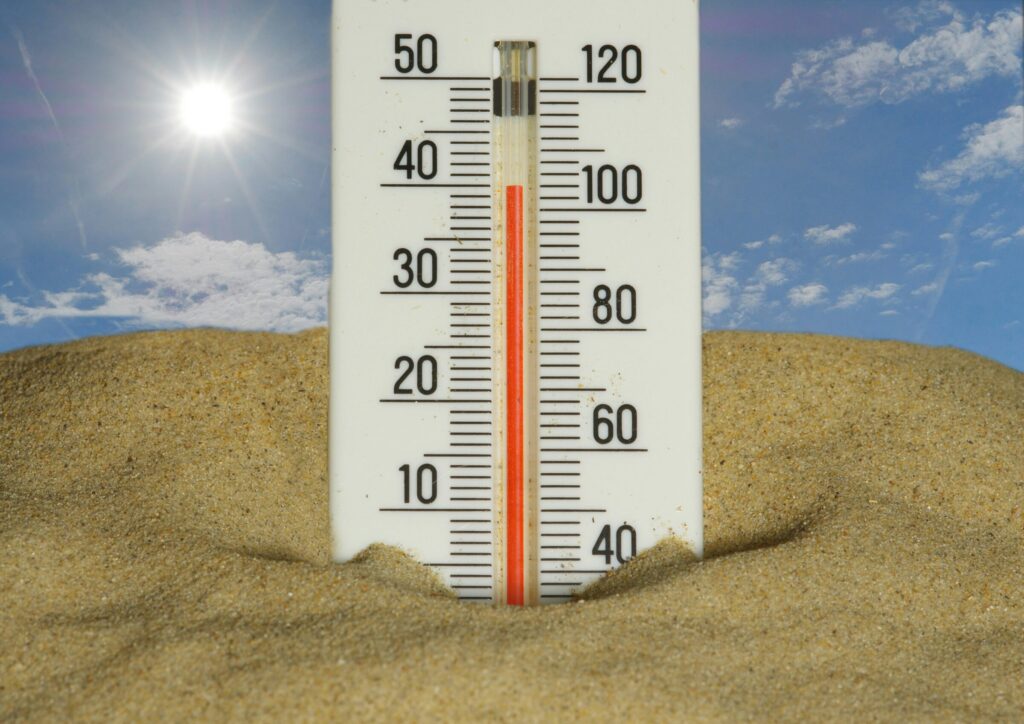
Hot weather is in the news alot at the moment. The Met Office has issued Heat Health Alerts across much of England for the week ahead, with temperatures forecast to reach 32 to 35 degrees Celsius – approaching the threshold at which all vigorous outdoor activity should stop. For many schools, this will be the hottest week of the year. And most of them will not have a plan.
And if you have been watching the Football World Cup, you will have seen the water breaks.
Every thirty minutes, play stops for three minutes. Players cluster around their coaches. Fans boo. Television cuts to adverts. The debate that has followed – dubbed “water-gate” in some quarters – has largely focused on commercial motives, momentum disruption, and whether FIFA is using player welfare as cover for creating new advertising inventory.
That debate is missing the point.
The reason the breaks exist is entirely legitimate. Players competing in 35 to 38-degree heat in cities like Miami and Dallas face real physiological risk. Structured hydration reduces that risk. The controversy is not about whether athletes need water in extreme heat. It is about whether FIFA got the implementation right.
The underlying science is sound. And it applies just as much to a school sports afternoon in the UK as it does to a World Cup quarter-final.
Every summer, the same pattern repeats itself.
A warm spell arrives after weeks of cool, grey weather. Teachers look at the forecast on a Friday evening and think: finally. Saturday afternoon’s fixture goes ahead. Students who have spent the last month sitting in classrooms suddenly find themselves sprinting around a sports pitch in 32-degree heat.
And sometimes, it ends badly.
Heat-related illness in school sport is not rare. It is not confined to extreme weather events or overseas tours. It happens on ordinary warm afternoons in the UK, during regular fixtures, to young people who are fit, motivated, but entirely unprepared for what their bodies are about to experience.
The frustrating thing is that it is almost entirely preventable.
The problem is not the heat. It is the transition.
The human body is remarkably good at adapting to heat. With gradual exposure over ten to fourteen days, it learns to circulate blood more efficiently, sweat more effectively, and maintain core temperature even during intense exercise.
That process is called acclimatisation.
The first warm days of the year are dangerous precisely because acclimatisation has not happened. Students who have trained indoors all winter, or who have had weeks away during the Easter break, arrive at their first warm-weather session in a completely unprepared physiological state.
Add high humidity – which prevents sweat from evaporating and sharply reduces the body’s ability to cool itself -and the risk compounds further.
This is not a fringe scenario. It is the most common context in which heat illness occurs in school sport.
Heat Illness Is a Spectrum
There is a tendency to treat heat illness as a binary. Either something serious happened, or it didn’t.
The reality is more nuanced.
Heat illness exists on a spectrum, from mild fatigue and cramps through to heat exhaustion – and at the severe end, heat stroke, which is a life-threatening medical emergency carrying a real risk of death or permanent harm if not treated with extreme urgency.
Most people are reasonably familiar with heat exhaustion: the student who looks pale and clammy, feels dizzy, and needs to sit down. The instinct is usually correct – get them to shade, cool them down, give them water.
Heat stroke is different. And understanding the difference matters enormously.
A student in heat stroke is not simply a student with worse heat exhaustion. Their body’s temperature regulation has failed entirely. They may be confused, agitated, or aggressive. They may collapse. They may stop sweating. Core temperature can exceed 40 degrees Celsius.
This is a 999 situation. It should be treated as such immediately.
The rule we use at Meliora Medical is simple: if you are not certain whether you are looking at heat exhaustion or heat stroke, treat it as heat stroke and call 999.
The cost of overcalling is a slightly unnecessary ambulance. The cost of undercalling can be a death that was preventable.
Humidity Changes Everything
Temperature is only part of the story.
A 28-degree day with high humidity can be considerably more dangerous than a 32-degree day with a light breeze and low humidity. The mechanism is straightforward: when relative humidity is high, sweat cannot evaporate efficiently from the skin, and the body’s primary cooling system stops working properly.
Many schools and coaches are not routinely checking humidity before outdoor sessions. They should be.
When relative humidity exceeds 50%, we recommend applying the next risk level up (see below) from the temperature alone. A day that would otherwise warrant moderate precautions should be treated as a high-risk day. This is not overcaution – it is an appropriate response to the physiological reality.
Direct sun, still air, and time of day all compound the risk further. Peak radiant heat is typically between 11am and 3pm. Where possible, intensive outdoor activity in warm conditions should be scheduled either side of that window.
What Good Decision-Making Looks Like
The most common failure we see in schools is not indifference to heat risk. It is uncertainty.
Teachers and coaches want to make good decisions. But they are often unsure exactly when a warm day requires a change in approach, how significant a change is warranted, and who has authority to make that call.
The result is inconsistency. One teacher makes a sensible modification. Another, in the same school on the same day, runs a full session without adjustment.
Consistency requires a shared framework.
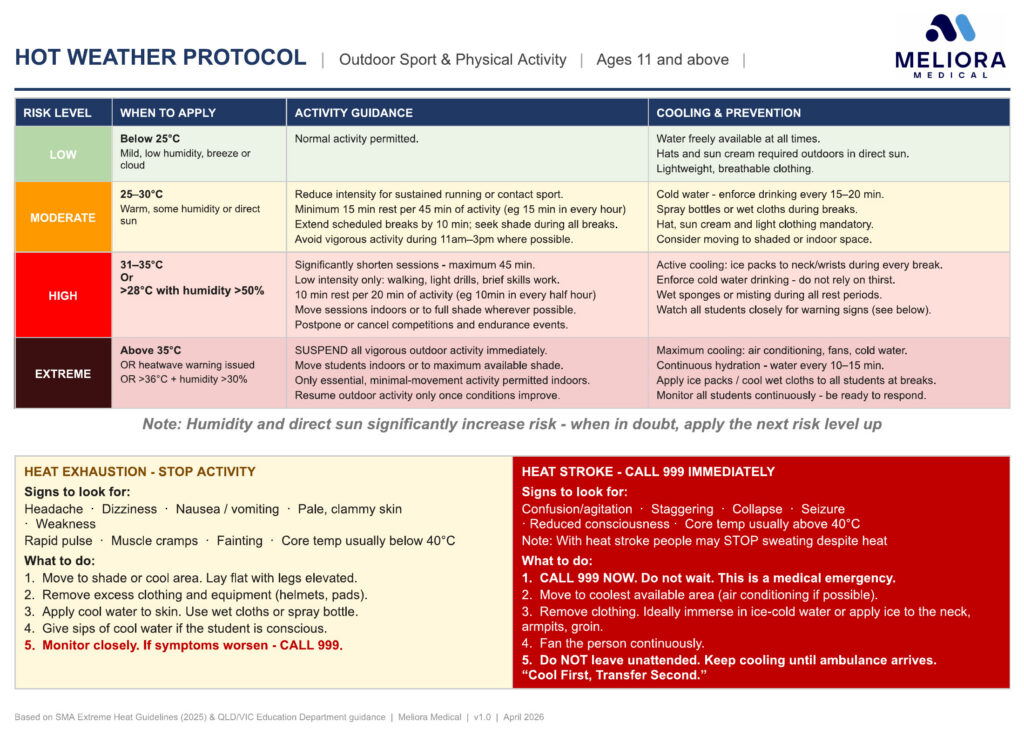
That is why Meliora Medical has developed a Hot Weather Protocol for schools and sports clubs, specifically designed for the management of outdoor sport and physical activity involving young people of senior school age (11+)
The protocol uses a four-level traffic light framework:
- Low risk (below 25°C): normal activity, with water available and sun protection in place.
- Moderate risk (25–30°C): reduced intensity, mandatory breaks, increased hydration.
- High risk (31–35°C and humidity above 50%, or feels very hot): significantly shortened sessions, low intensity only, active cooling during all breaks.
- Extreme risk (above 35°C, or a heatwave warning issued): all vigorous outdoor activity suspended immediately.
Each level specifies what activity should look like and what cooling measures should be in place. It is designed to be followed by a non-specialist – a PE teacher, a coach, a member of staff supervising a lunchtime activity.
Student Safety Takes Precedence
One of the principles embedded throughout the protocol is that student safety takes precedence over completing a session, winning a fixture, or meeting a curriculum target.
That principle should not need stating. But experience tells us that it does.
There is a particular culture in school sport – not unique to any one institution – that values commitment, resilience, and getting through. These are genuinely important qualities. But they can, in the wrong context, create pressure on students to continue activity when their bodies are telling them to stop.
Young people are less likely than adults to voluntarily reduce their effort in response to early warning signs of heat illness. They are more likely to suppress symptoms, keep going, and say they are fine when they are not.
This is not a character flaw. It is a predictable feature of adolescent sport. Which is why the protocol places the responsibility firmly with supervising adults rather than individual students.
If a student says they feel unwell in hot conditions, that is taken seriously. Always.
A Resource Designed to Be Used
The Meliora Medical Hot Weather Protocol – including the full policy document and the quick reference card is available to download from this page.
Australia leads the way with these sorts of policies and so we have drawn on much of their published guidance including Sports Medicine Australia’s Extreme Heat Risk and Response Guidelines (2025), alongside the Queensland and Victorian Departments of Education’s heat management frameworks. It is evidence-based, practical, and written for non-specialists.
Heat illness in school sport is almost entirely preventable. The evidence, the frameworks, and the practical tools are available.
What remains is simply the decision to use them.
The Meliora Medical Hot Weather Protocol is available to download above.
For further information about how Meliora Medical can support your school’s health and safety provision, please contact our team.