
Dr Sam Barke, Head of Sports Medicine
England Rugby has delayed the start of much of the competitive community rugby season until the week commencing 21 September, following the prolonged dry weather and the effect this has had on pitches across the country. See statement here
The announcement is significant for obvious reasons. Many pitches are currently extremely hard and, in some cases, unsuitable for normal full-contact rugby.
But one part of England Rugby’s reasoning is particularly relevant to schools: player readiness.
Many teams will already be having to reduce or modify contact training because of the ground. England Rugby has highlighted the particular concern of players returning to full contact without having had the usual opportunity to prepare for it.
For the schools we work with, that feels especially important.
School fixtures do not all fall within the competitions that have been postponed. But the fact that a fixture is technically able to go ahead is not the same as saying that it should. The pitch still needs to be properly assessed.
That is why we have produced a new Meliora Medical Hard Ground Protocol and Quick Reference Guide for the schools and organisations we support.
[Access the Meliora Medical Hard Ground Protocol here]
But in school rugby, assessing the pitch is only part of the job. We also need to think about the young people who are about to play on it.
Hard ground has interrupted normal pre-season
A normal pre-season gives coaches time to progressively rebuild rugby-specific exposure.
Running volume increases. Sprinting returns. Contact is reintroduced. Tackling, rucking, scrummaging and repeated player-to-ground work are gradually built back in before competitive rugby starts.
This summer has made some of that more difficult.
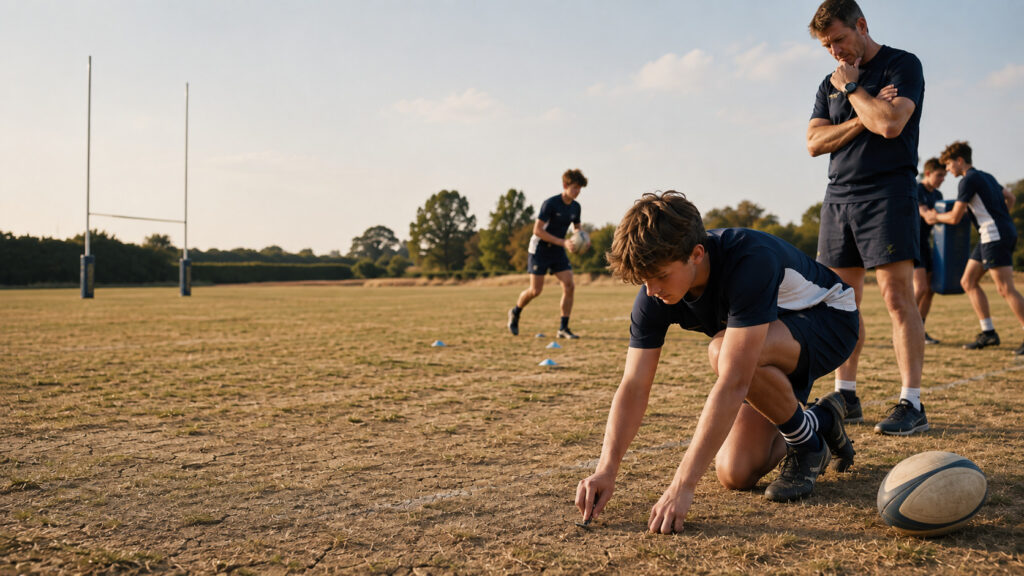
Where pitches have been particularly hard, sensible coaches have quite rightly modified sessions. Repeated tackle-to-ground work may have been reduced. Contact sessions may have been shortened or moved. Some schools will have access to an artificial surface; many will not.
England Rugby’s advice reflects this. Rather than simply stopping training, it recommends modifying impact exposure while continuing to prepare players through work such as ACTIVATE, body management, footwork and tracking, wrestling and grappling.
That is sensible. But it also means that when the pitches do improve, some players may have had much less exposure to full rugby contact than they normally would by that point in pre-season.
In adolescents, readiness can vary enormously
This is where school rugby differs from simply applying the same approach to a group of adults.
Within one adolescent squad, players can return after the summer in very different places.
One may have followed a conditioning programme closely. Another may have played another sport all summer. Another may have done relatively little high-speed running or rugby-specific work. And Some will also have grown considerably since the end of term.
That matters because adolescents of the same age can be at very different stages of physical development. Size, strength, coordination and physical maturity can vary significantly within the same team.
None of that means adolescents are inherently fragile, or that they should be protected from rugby-specific demands.
They need those demands in order to become prepared for them.
But it does mean that a squad is unlikely to return to rugby with a single, uniform level of readiness.
And if hard ground has already limited how much contact can be introduced, those differences become more relevant.
A softer pitch does not immediately solve the problem
At some point, conditions will improve. A few days of rain may make a substantial difference to a pitch.
But the players will not necessarily change at the same speed.
If a group has spent several weeks doing relatively little tackle-to-ground work, repeated contact or rucking, it makes sense to think about how those demands are reintroduced rather than simply moving immediately into a full competitive match.
For an adolescent who has also grown over the summer, returned relatively deconditioned, or had little recent contact exposure, that transition may need even more thought.
This is where the interaction matters.
A hard pitch on its own is one consideration.
Limited pre-season contact is another.
Variable conditioning is another.
Growth and physical development may be another.
The sensible approach is to consider them together rather than in isolation.
Training gives you options that matches do not
Training is relatively easy to modify.
If the ground is firm, a coach can reduce repeated player-to-ground exposure, shorten a contact block, spend more time on footwork and tracking, use wrestling or grappling, or move certain parts of the session elsewhere.
A match is different.
Once it starts, the nature of rugby takes over. Tackles, falls, rucks, aerial contests and unplanned player-to-ground contact cannot be meaningfully controlled.
England Rugby makes this point in its discussion of friendlies. A friendly is not inherently safer than a competitive match simply because there are no league points attached. Full-contact rugby still requires suitable conditions, appropriate preparation and a proper risk assessment.
That is highly relevant to schools that fall outside some of the current competition restrictions.
A pitch might pass a local assessment.
The next question should be whether the players have had enough preparation for what the match will ask of them.
Assess the pitch, but know the group
Our Hard Ground Protocol was developed following England Rugby’s earlier drought guidance and provides a practical framework for assessing the playing surface.
It considers the pitch as a whole rather than relying on a single test, including stud penetration, cracking, grass coverage, localised hazards and, where available, Clegg hammer readings.
But the protocol deliberately supports judgement rather than replacing it.
The same pitch may reasonably lead to different decisions depending on the activity planned.
And in school rugby, we would add one further question: who is the session for?
Schools should consider:
- how much contact preparation the players have actually had;
- how recently they have been exposed to full tackling and repeated player-to-ground contact;
- the demands of the planned session or fixture;
- whether the group contains players at very different stages of preparation;
- and whether training can be modified while conditions improve.
A well-conditioned sixth-form group with several weeks of progressive rugby exposure is one scenario.
A younger squad in its first few sessions back, with widely varying levels of conditioning and physical maturity, is another.
The pitch may be identical. The context is not.
The decision is therefore not simply:
“Is the ground soft enough?”
It is:
“Are the pitch and the players both ready for what comes next?”
Use the next few weeks well
If contact has to be modified while pitches remain hard, there is still plenty that can be achieved.
Players can rebuild running exposure and sprinting. Strength work can continue. Footwork, tracking and body management can be developed. Contact skills can be practised without repeatedly putting players onto an unforgiving surface.
For adolescent squads, it is also an opportunity to notice who has come back well prepared, who has changed physically over the summer, and who may need a more progressive return to rugby-specific demands.
Then, when conditions allow fuller contact to return, that exposure can be built back in appropriately.
The current focus is understandably on the ground.
But in school rugby, the decision should always include the young people standing on it.
A suitable pitch matters. So does having players who are ready for what you are about to ask them to do.