
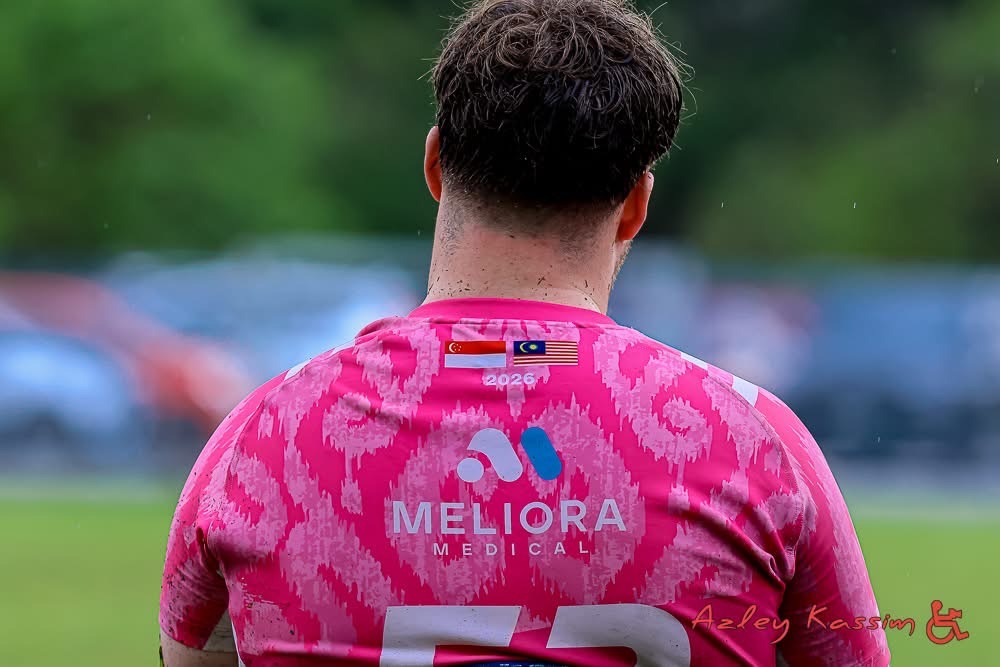
Putting Theory into Practice: Lessons from the Lambs RFC Tour to Singapore and Malaysia, July 2026
Liz Robson, Head of Performance Physiotherapy
When people think about a rugby tour, they picture the matches, the tries, and the lifelong memories. What they rarely see is the work happening behind the scenes.
This summer, I had the privilege of traveling with the Lambs RFC to Singapore and Malaysia as the tour physiotherapist for their 20th anniversary. While rugby was undoubtedly the centerpiece, my role extended far beyond assessing injuries and running onto the pitch with a medical bag. I was “tour mum” to twenty-four 18-year-olds and five staff members, a multifaceted role that included ice-cube distributor, hydration police, orange slicer, and food critic.
With temperatures consistently above 30°C, humidity often reaching over 90%, and four matches in little over a week, every decision had the potential to influence the welfare and performance of the entire group. In this environment, success wasn’t measured by how many injuries we treated, but by how many problems we prevented. Sports medicine became a constant balancing act between maintaining performance, minimizing fatigue, and protecting player health.
The reality is that most of the work happened long before kick-off.
In the weeks before departure, with the support of Meliora Medical’s Head of Sports Medicine, Dr Sam Barke, I developed a tour-specific hot weather policy and medical protocol to prepare for the unique physical demands of playing rugby in high heat and 80%+ humidity.
This preparation included reviewing medical records and injury statuses, producing Emergency Action Plans (EAPs) for every training and match venue, and researching local hospitals to ensure we were prepared for any contingency.
Regular Lambs management meetings ensured every staff member understood the heat protocols and their individual responsibilities. By the time we arrived in Singapore, we weren’t improvising; we were executing. We had already discussed the scenarios and agreed on the processes, allowing us to focus on creating an environment where players and staff could perform safely.
The Environment Dictated Everything
The biggest opponent on tour wasn’t the team across the pitch, it was the climate. For players arriving from a British summer, the heat and humidity of Singapore and Malaysia presented a severe physiological challenge. High temperatures combined with high humidity reduce the body’s ability to dissipate heat, leaving players more susceptible to fatigue, dehydration, and heat-related illness.
Rather than trying to fight the environment, we chose to work with it. Every decision throughout the tour was guided by one question:
“Will this help the players perform better in the heat and humidity?”
Hydration as a Tactical Advantage
From the moment we touched down, hydration became the team’s mantra. Every player carried a 1.5-litre water bottle everywhere, on the coach, during cultural excursions, and at team meetings. The players quickly bought into the process, recognizing that hydration was fundamental to their ability to recover and perform.
Match days were a logistical feat. Per game we utilized:
- 60 + litres of water
- 30 kilograms of ice
- 2 Watermelons
- 2 bags of Oranges
- 2 tubes of hydration tablets
We also introduced “ice-bibs“, substitute bibs soaked in freezing water, for players coming off the pitch. It was the most coveted piece of equipment on the bench, ensuring the boys could cool down instantly and remain “ready to smash it.”
None of these interventions were complex, but collectively, they made a significant difference.
Every Small Detail Matters
Match-day decisions were less about tactics and more about survival. We slashed warm-ups to minimize sun exposure, keeping sessions concise to ensure every movement was purposeful and intentional. We didn’t want players running around unnecessarily; in that heat, every second of exertion had a cost.
This vigilance applied to everyone. Coaches and staff paced the sidelines clutching water bottles like lifelines. Good decision-making is impossible when your brain feels like a “dehydrated raisin,” and a staff member passing out was never the strategic advantage we aimed for.
Our management meetings, whether over dinner or crammed onto a coach, became high-stakes investigations into hydration. In that humidity, looking out for each other was the only way any of us made it to the final whistle.
Building a “One-Team” Culture
One of the most rewarding aspects of the tour was seeing how quickly everyone embraced a shared responsibility for player welfare. Everyone became part of the performance team:
- Coaching Staff: Streamlined logistics to conserve player energy.
- Parents: Formed a tactical “orange-and-watermelon distribution unit.”
- Injured Players: Stepped up as essential support staff, managing equipment and live-stream commentary.
Crucially, this shared responsibility served as a vital fail-safe; if I was occupied with an injury, the support system didn’t skip a beat. Our success wasn’t down to a single medical tweak, but the creation of a “one-team” culture where everyone understood that their contribution was the foundation of our safety.
Less Training. Better Performance.
Our traditional style of play relies on coming out hard and fast to rack up scores early. In our first game, we did exactly that, only to hit a wall in the second half. It became clear that we needed to change our tactics, adapting how we played on the pitch while simultaneously changing how we managed ourselves off the pitch to preserve our resources.
We made the bold call to scrap all field training between matches. Let’s be honest: running drills and training in 90% humidity is a recipe for disaster, not winning. Instead, we swapped the pitch for the pool, using water-based mobility, mass relay races, and games of Marco Polo to keep the squad sharp and moving without the added heat stress.
The strategy paid off. By shifting our approach, we successfully won three out of four games against strong local opposition who were already acclimatised to the extreme heat and humidity.
It was a calculated shift from doing ‘more’ to doing what actually mattered, and it proved that sometimes the most effective coaching intervention isn’t adding another session, it’s having the confidence to remove one.
The Bigger Picture
Looking back, the rugby matches will be remembered, but what resonates most with me is the culture we built. I’ll remember coaches carrying kicking tees to save player energy, parents slicing watermelon in the heat of the game, and young men who fully embraced every strategy we introduced.
High performance isn’t built by one individual; it is built through preparation, communication, trust, and hundreds of small, seemingly insignificant decisions that collectively create an environment where people can thrive.
If there is one lesson from the Lambs tour, it’s that sports medicine is not merely reactive; it is an active, collaborative effort to shape the environment for success. For me, that is what sports medicine really is:
“understanding the environment and creating the conditions that allow athletes to perform at their very best”
For further information about how Meliora Medical can support your school’s health and safety provision, please contact our team.